Securing a sustainable and resilient food future relies heavily on collaborative research, strong partnerships, and bold scientific innovation. This vital imperative took centre stage on 30 June 2026, as the International Food Policy Research Institute (IFPRI) joined global leaders at the Safari Park Hotel in Nairobi, Kenya, for the inaugural DialogueNEXT Africa conference. A landmark event hosted by the World Food Prize Foundation under the theme "Born to Feed the Future", exploring how the continent can lead sustainable global food production.
For IFPRI, the conference served as a premier platform to showcase research, engage key stakeholders, and advocate for evidence-based policymaking. The team, represented by Kenya Country Program Leader Dr. Khalid Siddig, along with Sam Gituro and Mary Theuri, welcomed delegates to an interactive exhibition stand. There, they highlighted the institute's targeted initiatives across the continent to strengthen food systems, improve agricultural productivity, and promote inclusive economic growth. The vibrant exchanges at the stand underscored the critical role of collaborative, data-driven research in addressing regional food security.
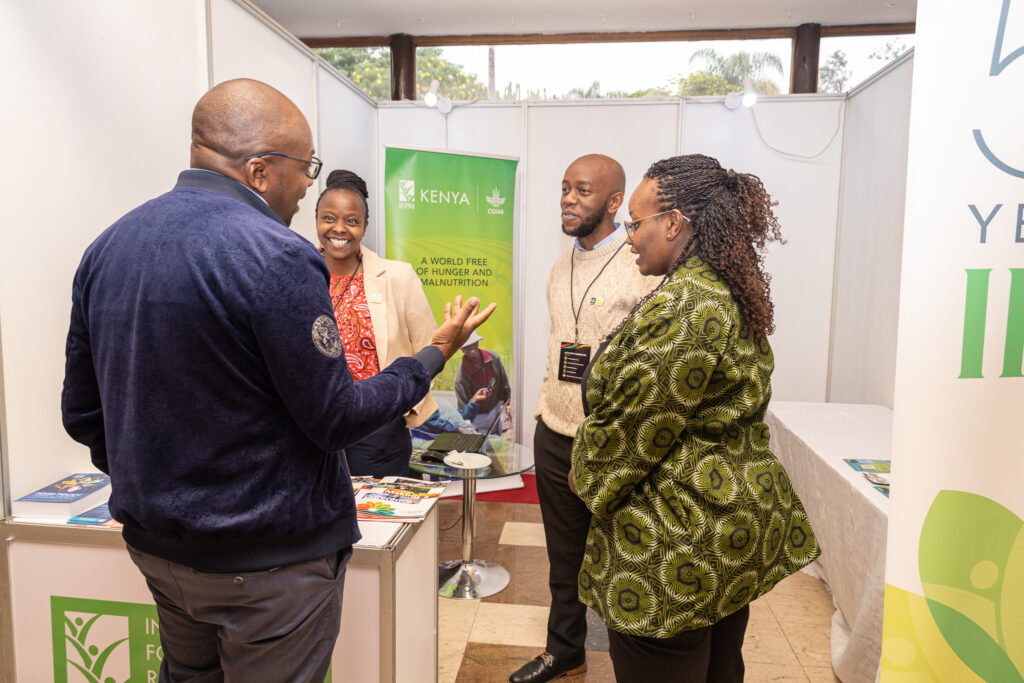
Engaging with participants at the IFPRI exhibition stand during the conference.
Throughout the day, high-level discussions focused on the key pillars of agricultural transformation. They centred on farmer-centred innovation, demonstrating how research and extension services must align directly with the practical needs of smallholders. Sessions on digital agriculture and technology explored how artificial intelligence, mechanisation, and precision farming can build climate resilience. Recognising the human drivers of this transformation, delegates also celebrated the contributions of women across agricultural value chains and showcased dynamic young agripreneurs developing disruptive business models. Crucially, participants examined how enabling regulatory frameworks and strategic investments can stimulate private-sector participation to scale these innovations.
A resounding theme of the event was that Africa’s food systems transformation must be actively driven from within. As Dr Akinwumi Adesina, 2017 World Food Prize Laureate, noted, hosting this conversation in Africa is not merely symbolic but necessary. He emphasised that while challenges such as climate shocks and fragile supply chains are real, the solutions are increasingly being pioneered by African scientists, farmers, and entrepreneurs.
The event concluded with climate-smart innovation exhibitions, policy networking, and technical immersion visits to leading local research institutions. For IFPRI, these interactions underscored the need for deep collaboration among governments, national research systems, CGIAR centres, and the private sector.
Building resilient and nutritious food systems requires sustained investment in research, supportive policy frameworks, and the meaningful inclusion of women and young people. As we look ahead to the Norman E. Borlaug International Dialogue in Des Moines, Iowa, on 20–22 October 2026, insights from Nairobi will continue to shape the global agricultural agenda, driving collective action towards a food-secure future.
Author
Audrey Mandi, Communications consultant, IFPRI
Photo credit: World Food Prize Foundation communication desk