Authors: Berber Kramer, Sedi Boukaka, Antonate Owuor
Across Kenya’s agricultural and food systems, a large amount of CGIAR-generated evidence on what works exists, but it often remains fragmented. Differences in approaches, indicators, and evaluation designs make it difficult to connect findings across studies and build a clear, country-level picture of impact.
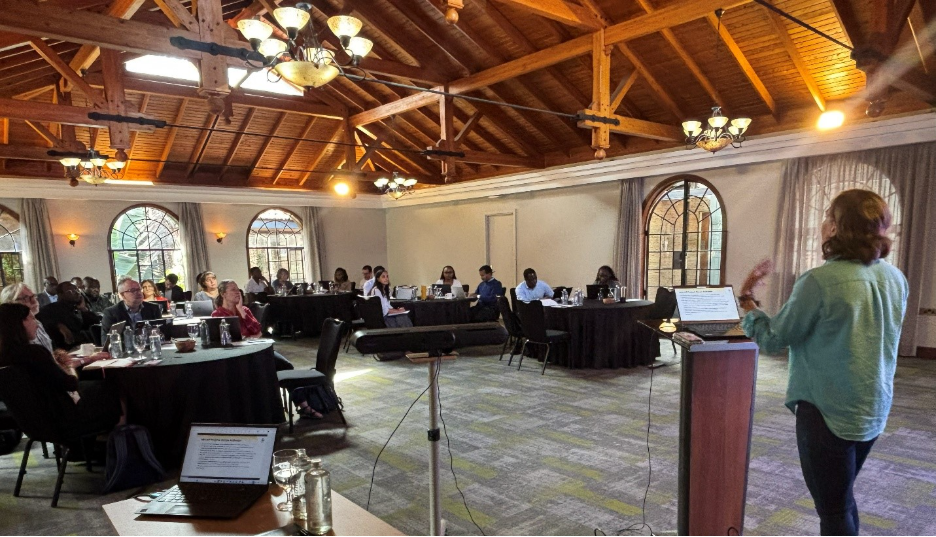
On April 9, 2026, the MELIAF Kenya Activator team brought together CGIAR researchers and a small number of national and international partners involved in data collection, evaluation, and evidence generation in Nairobi for a hands-on Theory of Change (ToC) Co-Design Workshop focused on strengthening how impact is understood, measured, and communicated across Kenya’s agricultural and food systems.
To address this, the workshop focused on co-developing a shared Theory of Change linking Kenya’s priority challenges to measurable outcomes, impacts, and contributions. Building on prior desk reviews and working group discussions, participants engaged in interactive breakout sessions, working across six priority areas (including productivity, markets, nutrition, climate resilience, inclusion, and environment) to:
- Refine outcome-impact pathways grounded in national priorities
- Clarify how CGIAR innovations, policies, and capacity development efforts contribute alongside other actors
- Identify key stakeholders and make assumptions and constraints explicit
- Shortlisting a first set of common indicators to enable cross-study learning, aggregation of results and evidence synthesis
The workshop produced a first set of policy-relevant and measurable pathways that will form the backbone of a Kenya-wide Theory of Change framework. This will help improve coordination across evaluations, reduce duplication, and strengthen how evidence is aggregated and used for decision-making. The workshop also highlighted concrete opportunities for collaboration, including aligning survey instruments and integrating common indicators into ongoing studies.
By linking individual evaluations and research initiatives to broader country-level pathways and outcomes, the MELIAF Kenya Activator aims to support stronger storytelling around how CGIAR and partner contributions collectively shape agricultural and food systems transformation in Kenya. The Lexicon, an NGO that uses story-based design thinking, information art, and collaborative expert networks to accelerate the adoption of sustainable practices in food, agriculture, and conservation, participated in the workshop and will play a growing role in this, supporting the documentation of selected studies and strengthening how evidence contributes to CGIAR’s broader impact narrative in Kenya.
The Kenya Activator is also viewed as a potential model for how country-level MELIAF systems could be operationalized across CGIAR. By combining a shared Theory of Change, harmonized indicators, coordinated evidence generation, and synthesis-oriented learning, the process offers a practical approach for moving from isolated evaluations toward more connected and policy-relevant evidence systems. While still at an early stage, the experience in Kenya may provide useful lessons for similar efforts in other countries and regions.
The next phase will focus on refining the pathways, further developing the indicator framework, and strengthening engagement with national partners.
If you are interested in contributing, whether through the ToC working group, indicator development, the seminar series, or synthesis work, please reach out to the MELIAF Kenya Activator team at IFPRI (Berber Kramer, Sedi Boukaka and Antonate Owuor).