by Hazel Odhiambo, Research Officer, African Population and Health Research Center (APHRC); Rikki Agudah, Sustainable Agriculture Consultant, Wasafiri; Jaqueline Kungu, , APHRC; Sunny Kim, Senior Research Fellow, IFPRI; Naureen Karachiwalla, Senior Research Fellow, IFPRI; Julie Ghostlaw, Program Manager, IFPRI
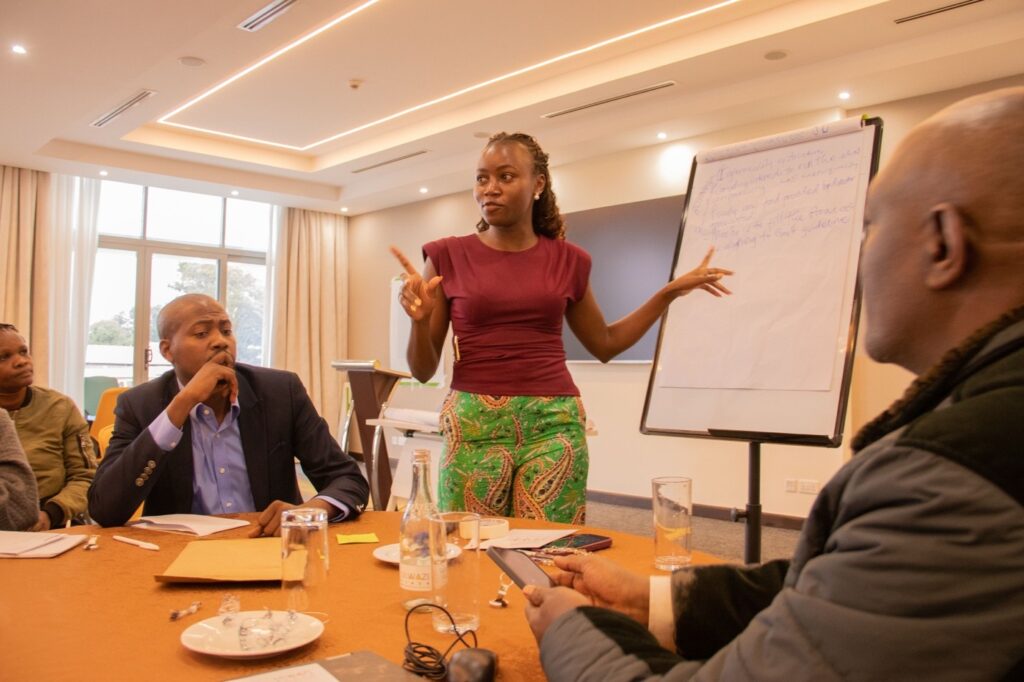
Nairobi, Kenya (June 16, 2026)––Participants deliberate solutions to address demand-side barriers to scaling school meals in urban informal settlements at a CGIAR workshop. Photo credit: Cleophas Adino, Child Space Organization
School meals are one of the world's most effective investments in children. They improve nutrition, increase school attendance, support learning, and create stable markets for local farmers and food businesses. In Kenya, the national School Meals Programme aims to expand from reaching roughly one-quarter of primary school children today to 10 million learners by 2030. This ambition faces a critical challenge: many schools in urban informal settlements—particularly low-cost private and Alternative Provision of Basic Education and Training (APBET) schools—remain disconnected from reliable food suppliers. Local micro and small enterprises (MSEs) and smallholder farmers (SHFs) have the potential to fill this gap but are largely excluded from the school food value chain. Bridging this gap requires more than expanding school feeding—it requires a scalable model that connects schools with local food producers, strengthens community demand for nutritious school meals, and creates sustainable market opportunities for local businesses.
To address this challenge, the African Population and Health Research Center (APHRC), and Wasafiri, alongside the International Food Policy Research Institute (IFPRI), with support from the CGIAR Scaling for Impact (S4I) Program, are developing a scalable "lean model" for locally-sourced, healthy, and sustainable school meals in Kenya's urban informal settlements. The bundled innovation combines local procurement, community demand creation, policy engagement, and evidence generation to strengthen both the supply and demand sides of school meals systems while creating new opportunities for local businesses and farmers.
On June 16–17, 2026, IFPRI, APHRC, and Wasafiri convened a two-day stakeholder consultation and Innovation Packaging and Scaling Readiness (IPSR) workshop in Nairobi, Kenya to refine the pathway for scaling this model. The workshop brought together representatives from national and county governments, development partners, local business associations, community organization groups, schools, researchers, and other stakeholders working across Kenya's school meals ecosystem. Using CGIAR's IPSR methodology, participants worked together to identify the key barriers, opportunities, and priority actions needed to expand locally sourced school meals in underserved urban communities.
Developing a roadmap to scale locally sourced school meals
The workshop centered around a shared scaling ambition: by 2028, IFPRI, APHRC, Wasafiri, and their partners aim to scale a school meals systems model that integrates MSEs and SHFs into local food procurement systems, reaching approximately 24,000 students while strengthening local food systems, supporting women's economic empowerment, and creating sustainable market opportunities for local agrifood businesses.
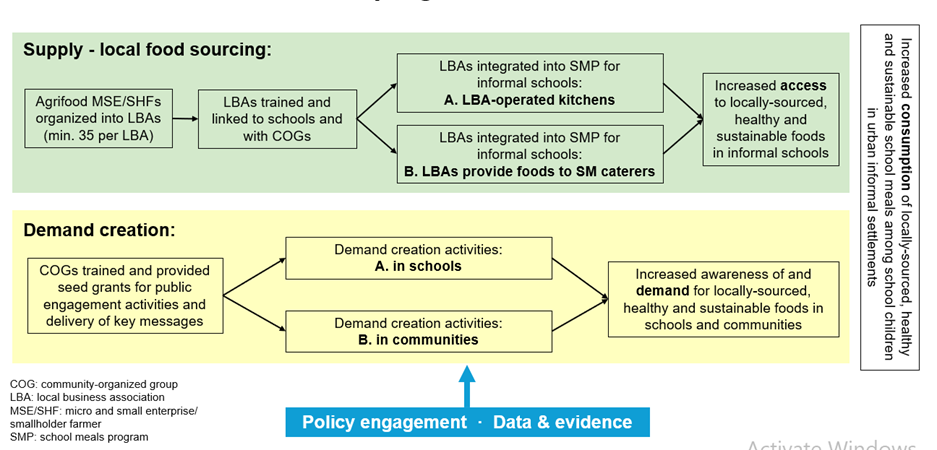
The solution extends well beyond simply connecting schools to suppliers. On the supply side, the project organizes MSEs and SHFs into Local Business Associations (LBAs), strengthens their capacity in food safety, procurement readiness, business operations, quality assurance, and logistics, and connects them directly with schools and caterers. On the demand side, Community Organized Groups (COGs) lead school- and community-based awareness activities—including cooking demonstrations, urban farming sessions, school outreach, and community dialogues—to increase demand for healthy, locally sourced foods. Policy engagement and evidence generation support both pathways to create an enabling environment for scale. The theory of change is shown below.
From diagnosis to action
Even the most promising innovation will fall short of impact if the conditions needed for scaling are not in place. Successful scaling depends not only on a strong solution, but also on the policies, partnerships, financing, market incentives, and community engagement that enable it to thrive. To this end, the IPSR workshop examined the broader system needed to enable scaling. Participants worked through a structured process to validate the scaling ambition, identify barriers, categorize them across the scaling pathway, prioritize enabling conditions, assess their readiness and real-world use, and ultimately develop practical action plans.
- Getting approved takes too long. The process for registering products and getting the green light from regulators is slow and hard to predict. Agencies don't always work off each other's decisions or coordinate well, so products get stuck waiting to reach the people who need them.
- Money and supply chains don't line up. Buying is scattered and uncoordinated, funding gaps and late payments create cash crunches, and weak planning around how much is actually needed leads to shortages and delivery breakdowns.
- Making and selling enough is a struggle. There isn't enough local manufacturing capacity, keeping quality consistent is tough, and unpredictable demand makes it hard for suppliers to know how much to produce.
Over the course of two days, stakeholders moved from diagnosis to action. Working groups prioritized solutions, analyzed the root causes behind key bottlenecks, and developed practical implementation plans with assigned responsibilities and timelines. The IPSR methodology also established 30- and 90-day milestones that will allow the project team to monitor progress, adapt implementation strategies, and strengthen partnerships as the scaling process unfolds.
Two action points were identified:
- Turn local suppliers into dependable partners. The goal is to help Local Business Associations (LBAs) become reliable, go-to suppliers for informal (APBET) schools, so these schools have a steady source of locally sourced meals.
- Build awareness and demand for healthy local meals. The second focus is getting schools, families, and other key players in target communities to understand, embrace, and actively want nutritious, locally sourced school meals.
Discussions highlighted that scaling locally sourced school meals depends on much more than an effective procurement model. Success will require coordinated action to strengthen policy and governance, improve financing and affordability, build trust and awareness among schools and communities, increase the capacity of local businesses, improve market access, and ensure that women, youth, and other marginalized groups benefit from new economic opportunities. Participants also emphasized the importance of stronger coordination across government entities to create a sustainable ecosystem for locally sourced school meals.
Why it matters
Kenya's commitment to expanding school meals presents an opportunity to transform not only children's nutrition but also local food systems. Home-grown school feeding has already demonstrated significant economic returns, with every US$1 invested generating an estimated US$2.26 in local income. Building on a successful pilot that demonstrated stronger market integration for MSEs and SHFs, this initiative seeks to adapt those lessons into a lean, cost-effective model that can be scaled across underserved urban communities.
As Kenya works toward reaching 10 million learners with school meals, scaling will require more than increasing coverage—it will require models that are practical, affordable, and sustainable. By developing and testing a lean procurement model that formally links organized MSEs and SHFs with schools while simultaneously strengthening community demand for nutritious school meals, the initiative seeks to demonstrate how locally sourced procurement can become an integral part of Kenya's national school meals system. Over the next two years, the program aims to expand to more schools in Nairobi county as well as to schools in Kisumu. If successful, the model will help improve children's access to safe and nutritious foods, create more reliable markets and jobs for local food businesses, and provide a scalable pathway for government and partners to strengthen school meals in underserved urban communities.
The stakeholder consultation was designed to produce more than discussion. It resulted in a shared scaling ambition, a system-wide understanding of the barriers that stand in the way of achieving it, and a jointly developed action plan that will guide implementation, partnership development, and adaptive learning. As the project moves forward, these partnerships—and the commitment to continuous learning and adaptation—will be critical to ensuring that locally sourced school meals deliver lasting benefits for children, local businesses, and communities across Kenya.
Acknowledgements
This research is being implemented under the CGIAR Scaling for Impact (S4I) Program by researchers from the International Food Policy Research Institute (IFPRI), in partnership with the African Population and Health Research Center (APHRC) and Wasafiri.
We sincerely thank all workshop participants for contributing their expertise and helping co-create a shared pathway for scaling locally sourced school meals in Kenya.
We also gratefully acknowledge all funders who support this research through their contributions to the CGIAR Trust Fund.